
KNF Smooth Flow Technology
Product Overview
6 Products


Note: Images are not to scale; for size comparison, please refer to the technical specifications or the actual product dimensions
KNF Smooth Flow Technology Pump Selection FAQ
How does “5-Diaphragm Technology” in KNF Smooth Flow pumps use phase shifts to reduce pulsation?
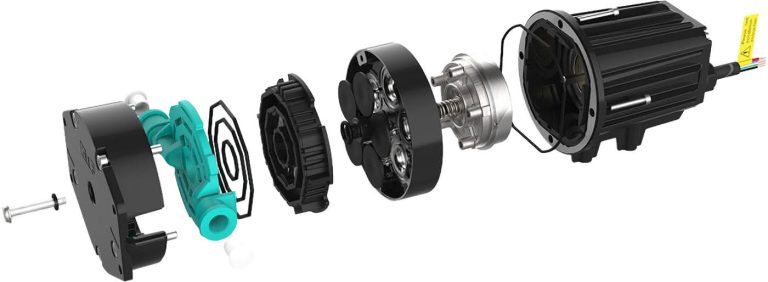
Models such as KNF FP 150 and FP 400 use 5 diaphragms connected in parallel. All operate at the same speed, but adjacent diaphragms are offset by one fifth of a cycle, equivalent to a 72° phase shift.
Staggered suction and discharge spread liquid delivery across more frequent, smaller pulses, reducing fluctuations in the combined flow.
According to the review, KNF 5-Diaphragm Technology reduces pulsation by a factor of approximately 10. Pressure fluctuations in an actual system still require assessment of operating conditions and tubing configuration.
How do integrated dampers smooth liquid delivery in smaller Smooth Flow pumps?
Smaller or micro Smooth Flow models, such as KNF FP 7, FP 25, and FP 70, use passive damper elements on the inlet and outlet sides. This reduces pulsation through a different mechanism from Five Diaphragm Technology.
On the outlet side, for example, the damper temporarily stores some liquid during discharge, then releases it during the suction stroke to fill the gap in outlet flow. Inlet damper elements help reduce periodic fluctuations in the suction line.
What is the difference between flow pulsation and pressure pulsation, and why is average flow insufficient?
Flow pulsation is the repeated variation in instantaneous flow during the pump’s suction and discharge cycles. Pressure pulsation results from the interaction of these flow changes with flow resistance, fluid column inertance, and pipe wall elasticity.
Even if average flow meets the requirement, instantaneous pressure can fluctuate substantially. Pressure-sensitive systems such as inkjet ink supply require assessment of pressure stability in the actual tubing, as well as operating flow. Average flow alone cannot establish smooth transfer.
Why do tubing material and pipe wall elasticity affect pressure pulsation?
Elastic tubing expands as pressure rises, temporarily holding more liquid, then contracts and releases liquid as pressure falls. This pipe wall capacitance interacts with fluid column inertance and pump pulsation frequency, changing pressure fluctuations in the line.
Tubing selection should therefore consider material, wall thickness, inner diameter, and length as well as chemical compatibility. Softer tubing may help damp pulsation, but it can also change the system’s dynamic response; softness alone cannot predict the outcome. Smooth Flow Technology reduces pulsation at the pump to help limit these tubing interactions.
Does reducing pump speed always reduce pressure pulsation in the tubing?
No. Reducing speed changes pulsation frequency, and tubing responds differently at different frequencies. The interaction of fluid column inertance and pipe wall elasticity may amplify pressure fluctuations at certain operating frequencies.
KNF’s tubing simulation case uses the same tubing and liquid volume per stroke, changing only the operating frequency. In the lower-speed case, tubing pressure was approximately twice that of the higher-speed case. Speed adjustment therefore requires assessment of the tubing’s dynamic response; pressure pulsation cannot be assumed to decrease with speed.
Why must solenoid valves and other tubing components still be assessed with Smooth Flow pumps?
Smooth Flow reduces pulsation generated by the pump’s suction and discharge cycles, but valves, filters, fittings, and narrow passages still affect flow resistance and operating pressure.
For example, rapid solenoid valve closure can cause sudden back pressure spikes and pressure waves. When integrating a Smooth Flow pump, assess valve switching, actual back pressure, and required operating flow together. Low pump pulsation does not eliminate every transient pressure peak during valve switching.
How does Smooth Flow reduce inlet pulsation and cavitation risk?
During suction, a diaphragm pump must overcome suction line resistance and accelerate the liquid column. Cavitation may occur if instantaneous local pressure falls below the liquid's vapor pressure.
Vapor pressure generally rises with liquid temperature, bringing inlet conditions closer to the cavitation threshold. Higher-temperature liquid transfer requires particular care in assessing suction lines and suction height.
Smooth Flow reduces periodic fluctuations through phase-shifted diaphragms or integrated inlet and outlet damper elements. Optimized internal flow paths also help reduce pressure losses. System measures include:
- Shorten suction lines: Position the pump as close as practicable to the reservoir and minimize suction height.
- Use suitable inner diameters: Avoid overly narrow suction lines and fittings that cause excessive pressure losses.
- Reduce additional resistance: Remove unnecessary bends, valves, and fittings, and confirm adequate flow capacity of inlet components.
Can actual operating conditions be simulated free of charge before selecting a KNF Smooth Flow pump?
Yes. The KNF Nautilus fluidic system simulator is available free of charge online to help evaluate Smooth Flow liquid diaphragm pumps during selection.
Enter system conditions such as liquid density, motor speed, and pressure to assess candidate pump performance. Nautilus can also be used during subsequent selection and integration discussions to compare and refine configurations, helping reduce testing effort, accelerate selection, and improve integration efficiency.
Nautilus is designed for KNF Smooth Flow liquid diaphragm pumps. Check the tool’s model list for supported pumps. Visit the KNF Nautilus, or contact us with liquid properties and operating conditions for assessment by DRF.
